DJI
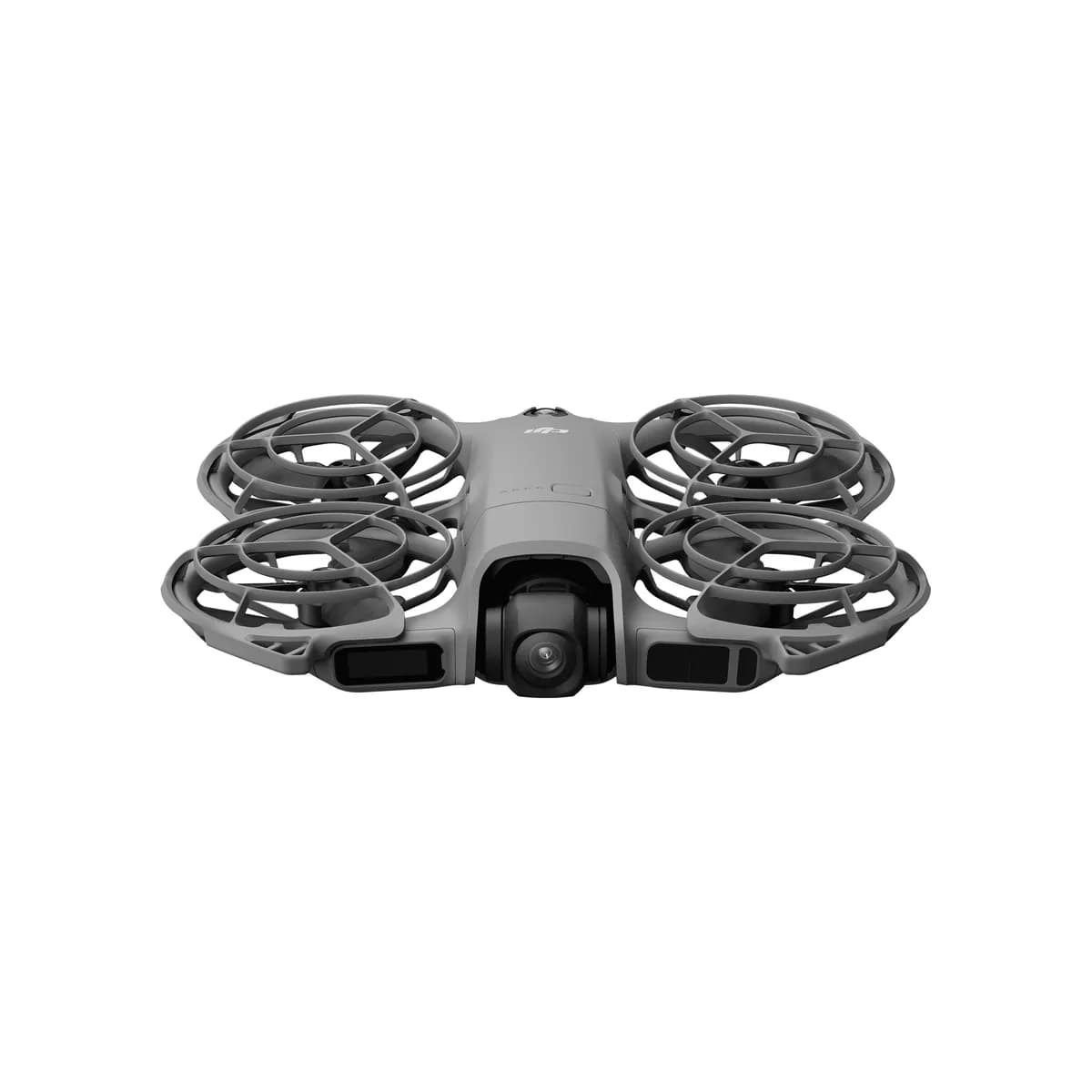
DJI Neo 2
Where the original Neo flew blind, its successor watches in every direction. DJI fitted the Neo 2 with an omnidirectional vision system plus a forward-facing LiDAR and a downward infrared sensor, while keeping the aircraft at 151 grams with guards on. The camera moved up to a 1/2-inch 12MP sensor on a two-axis gimbal, and 4K now runs to 100fps when you fly with a controller or motion controller. Out of the box it is still a palm-launch, gesture and phone drone on Wi-Fi with a 500-metre reach; the 10 km O4 figure only applies once you buy the separate Digital Transceiver and a controller. Internal storage is 49 GB with no card slot, and the pack is 11.5 Wh. For a US buyer the bigger question is supply: DJI launched it everywhere except the United States, so any unit here arrives through import channels without US warranty support.
The 250-gram line
Under 250 g: recreational flight needs no FAA registration, and Remote ID does not apply.
Every recreational flyer must also take TRUST and carry proof of it, at any weight. Rules from faa.gov. Not legal advice — how this is worked out.
Buying, flying and fixing it in the US
DJI filed the Neo 2 with the FCC in July 2025, before the 22 Dec 2025 Covered List cutoff, but left the US out of its 13 Nov 2025 global launch citing market conditions, so a US unit is an import with no US warranty; prices here convert DJI's Hong Kong list price (HK$1,669 base) because DJI publishes no US price.
- Buy it newImport only
- Never sold in the US by the maker; units here are imports with no US warranty.
- FCC authorisationPre-cutoff
- Authorised before the 22 Dec 2025 cutoff (granted 16 Jul 2025).
- FAA rulesNo registration
- Under 250 g, so recreational flight needs no FAA registration or Remote ID.
- Protection planNone in US
- No US Care Refresh; a plan bought abroad follows the region of purchase.
- RepairsNot published
- No US repair route published for it; DJI's warranty follows the region of purchase.
- Spare batteriesNone from DJI
- No US listing from DJI, and its new US store sells no drone batteries.
- App and accountAccount needed
- Flies with DJI Fly, listed in the US App Store, and is bound to a DJI account.
- Support commitmentNot published
- Not published by the maker.
DJI, across every model
- DJI is on the FCC Covered List by name. Models authorised before 22 Dec 2025 stay legal to sell and fly; new DJI models cannot be authorised.
- Since 5 Nov 2026 DJI's own store no longer serves US buyers. US sales moved to us.store.dji.com, run independently by BRICART Inc., which lists no drones and no drone batteries.
- Every DJI Care Refresh plan is marked discontinued for US buyers, so DJI crash cover can no longer be bought in the US.
- US repairs go to Care Pro (CarePro Technology Inc, Sacramento), the company DJI's US support page names for after-sales service.
- Aircraft are bound to a DJI account. Since June 2025 DJI will not unbind one without the original owner, which matters when buying used.
Every drone’s US status · Remote ID declarations. Stated as published by the maker, the FCC and the FAA; not legal advice.
Published sources: apps.apple.com, store.dji.com (1, 2, 3), imaging-resource.com, thedronegirl.com, fcc.gov, mayerbrown.com, us.store.dji.com, dji.com, tecarepro.com, dronexl.co
What that 19-minute claim is measured at
DJI's 19 minutes is measured in a windless wind tunnel at sea level, without the add-on Digital Transceiver fitted, flying forward at a constant 4 m/s with obstacle avoidance set to brake and the camera in photo mode, until a forced landing on an empty battery. Fit the propeller guards and DJI's own figure drops to about 17 minutes; hovering is rated at about 18.
That works out to 6.6 claimed minutes per $100 of the multi-battery bundle. Compared with the rest of the catalog.
Specifications
True first-year cost: ~$286 — the multi-battery bundle at ~$286; no crash plan on sale in the US has a verified price for this model, so nothing is added for it.
What it has
- Omnidirectional vision sensing plus forward LiDAR at 151 g
- 1/2-inch 12MP sensor on a two-axis gimbal
- 4K at up to 100fps with a controller, 60fps otherwise
- Palm takeoff, gesture control, SelfieShot and ActiveTrack
- Optional Digital Transceiver adds O4 with a 10 km FCC rating
- 49 GB internal storage, no microSD slot
In its favour
- Sensing on all sides plus LiDAR, which the original Neo lacked entirely
- A two-axis gimbal instead of the first Neo's single axis
- 4K/100 slow motion when flown with a controller
- Light enough at 151 g to stay clear of FAA registration for recreational flying
- Large 49 GB internal store, so no card to forget
Against it
- DJI does not sell it in the US, so there is no US warranty or official support
- The base kit is Wi-Fi only with a 500 m reach; O4 needs an extra transceiver and controller
- Single colour profile, with no log mode and no published bit depth
- No microSD slot, so the 49 GB fills and must be offloaded
- 19 minutes is a 4 m/s crawl figure, and the guards take it to about 17
The two lists above are drawn from the manufacturer’s published specifications and from the cited reviews, not from owner reports.
What owners report
Summarised from reports by people who own and fly it; a single report is written as one owner.
Owners use the Neo 2 to film themselves on the move: sprint training, mountain-bike rides, ski runs and car drives, one of them tracked hands-free. Owners who also had the first Neo describe the 2 as a clear step up, with a steadier two-axis gimbal and cleaner footage, and one owner was impressed how it avoided most branches on forest trails. One owner finds the slightly bigger body no longer slips into a pocket, and another finds the battery latch fiddlier to release.
Owners report ten to thirteen minutes of flying, and heat cuts that further: battery, processor and ESC overheat warnings show up in hot weather and under sport or acro flying, and one owner fixed it by opening the case and replacing the thermal paste with a pad. Water and launch behaviour cause some of the scares owners describe: one owner's drone drifted down and auto-landed into water while hovering, and another's darted backward on a launch from the drone, while one owner recovered the footage from a Neo 2 that sat 12 hours in salt water.
At 151 g it is the first drone for two owners, and one used it as a first step into FPV with Goggles N3. Owners who want more look to the Flip for better stills, or the Mini 5 Pro and Avata 360 as the next step; one US owner paid $308 for a three-battery kit shipped from South Korea in April 2026.
What owners like
- Follow and ActiveTrack keep up with runners, cyclists, mountain bikers and cars, and one cyclist tracks without touching a controller; owners use it to film sprint form, trail rides and road drives
- Owners who have flown both Neos say the 2 shoots clearly sharper, cleaner video; one credits the two-axis gimbal for less cropping and a lower ISO than the first Neo's electronic stabilisation
- Hand gesture control makes quick self-filming easy: one owner calls it super handy for quick launches and recovery, and another was surprised how smooth it is
- One small drone covers gesture flying, a regular remote and goggle FPV; one owner has flown it with gestures, goggles, a remote and waypoints, and two others recommend it as a way to try each style of flying
- Manual (acro) mode arrived by firmware in late November 2025, and several owners learned FPV on it with goggles; one went on from it to a tinywhoop and then 5-inch quads
- The guarded frame shrugs off typical knocks: one owner dropped it about 5 m onto concrete after hitting wires without a scratch, and others describe follow-mode crashes it survived unharmed
What owners ran into
- Owners report about 10-13 minutes per battery in real use, well short of the 19-minute claim, and one goggles flyer gets 6-7 minutes; one owner calls three batteries the sweet spot
- Overheat warnings come quickly in heat or hard flying: one owner at 95°F got a battery warning at 5-6 minutes, and another at 103°F got a processor warning in under 3 minutes
- In May 2026 one owner reported ESC overheat warnings within 3-4 minutes after firmware v01.00.0600, followed by a Return to Home that stalled and landed in a bush
- Water confuses the downward sensors: one owner's drone went into water twice in a week, the second time sinking lower while hovering about 10 feet up until it auto-landed
- Starting follow or Spotlight mode straight from the drone has sent it flying backward on takeoff for three owners; one never found it, and another chased it about a kilometre out over a river
- Obstacle sensing misses thin branches and is weaker to the sides and rear; owners have flown it into pine needles, a palm tree and side branches during follow or orbit shots
- Every controller needs the separate Digital Transceiver, which was scarce after Christmas 2025, and one owner finds its antennas and tiny screws a hassle when packing
- Stills disappoint two owners, including one with two decades behind a camera who found heavy noise even at ISO 200-400, distortion at 16 mm and no RAW, and bought a Flip
Questions owners ask
How long does a Neo 2 battery really last?
Do I need the Digital Transceiver to use my RC-N3, RC 2 or goggles with the Neo 2?
Is it safe to fly the Neo 2 over water?
Why does my Neo 2 keep showing overheat warnings?
Is the Neo 2 worth it over the original Neo?
How do US owners set up the Neo 2 for Part 107 flights over people?
Shopped alongside it
More from DJI →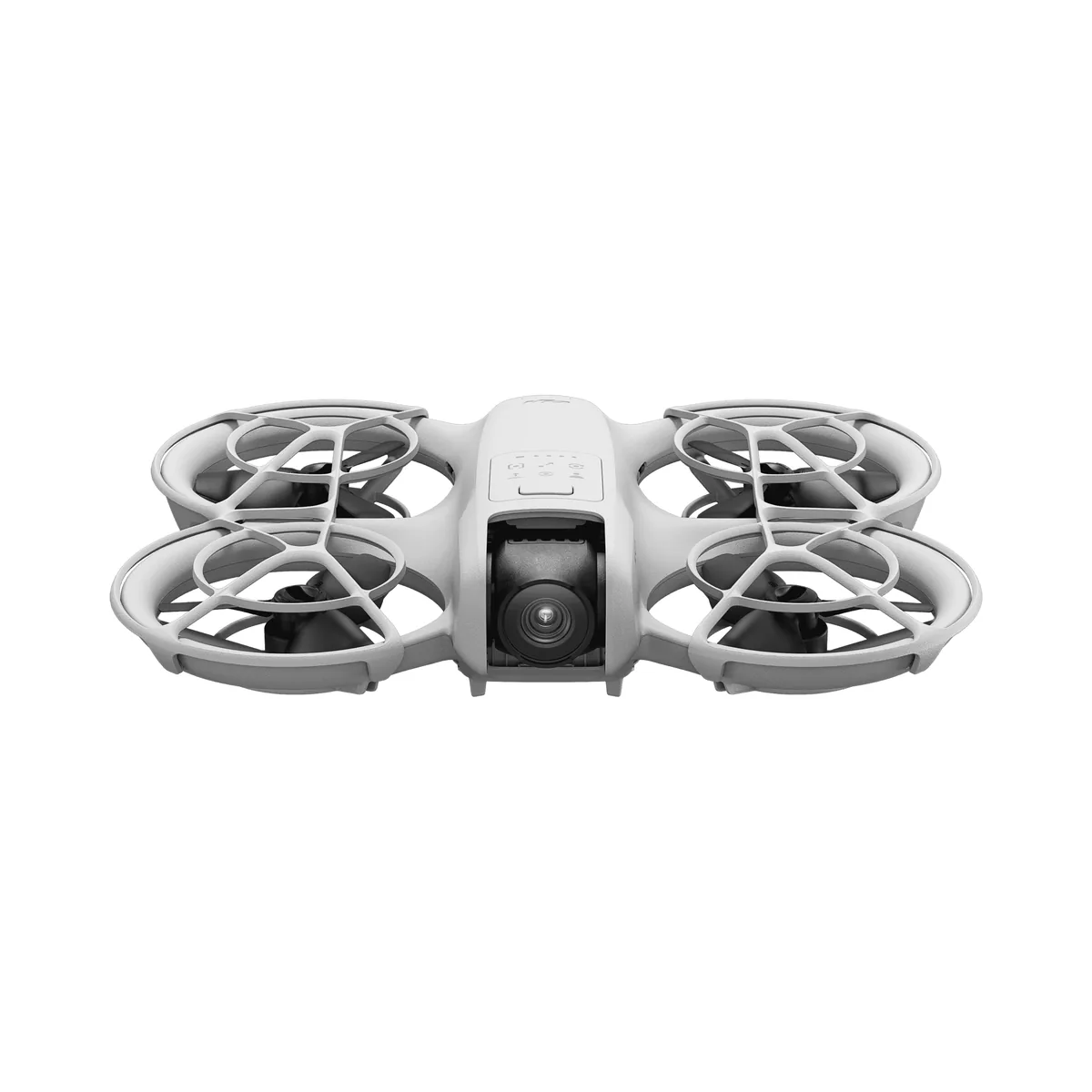
DJI
DJI Neo
At 135 grams with the propellers already caged, this is the drone you hand to someone who has never flown one. It launches off a palm, picks a preset move — orbit, follow, dronie — flies it, and lands back on the hand, with no controller and no app interaction required. A single-axis gimbal and electronic stabilisation keep 4K/30 usably steady, and 22 GB of internal storage means there is no card to forget. The trade is total: there is no obstacle sensing, the Wi-Fi link is good for about 50 metres without the optional controller, and the 18-minute claim is measured crawling forward at 2 m/s. Think of it as a hovering camera with eight fixed moves, not a camera drone you compose with.
- Sensor
- 30.7 mm²
- Claimed
- 18 min
- Bundle
- ~$289
Best for: Hands-free follow shots without piloting
Full spec sheet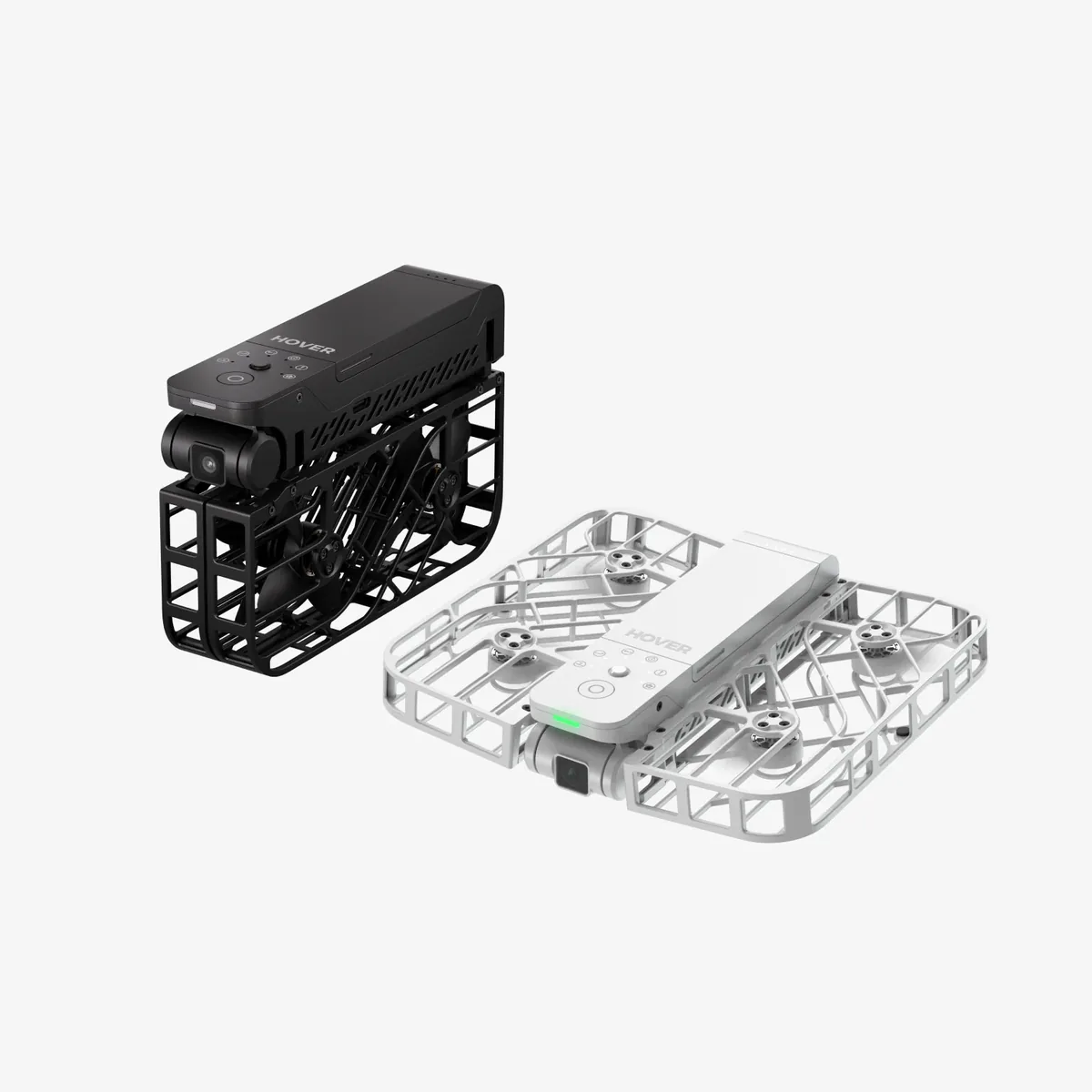
HoverAir
HoverAir X1
Zerotech's original palm-sized flying camera did one thing and did it before anyone else: you hold it out flat, press a button, and it lifts off, films a preset move around you, and lands back on your hand. No controller, no sticks, no app to fight with. A single-axis tilt gimbal plus electronic stabilisation holds 2.7K/30 HDR steady enough for social video, and a 1/2.3-inch sensor keeps it honest about what that footage is. What it lacks is everything a camera drone has — no GPS, no return-to-home, no obstacle sensing, and a Wi-Fi link measured in tens of metres. That is not a flaw so much as the category: this is a camera that hovers, aimed at people who want to be in the shot rather than behind it, and at 125 grams it never needs registering.
- Sensor
- 28.1 mm²
- Claimed
- 11 min
- Bundle
- ~$429
Best for: Being in the shot without learning to fly
Full spec sheet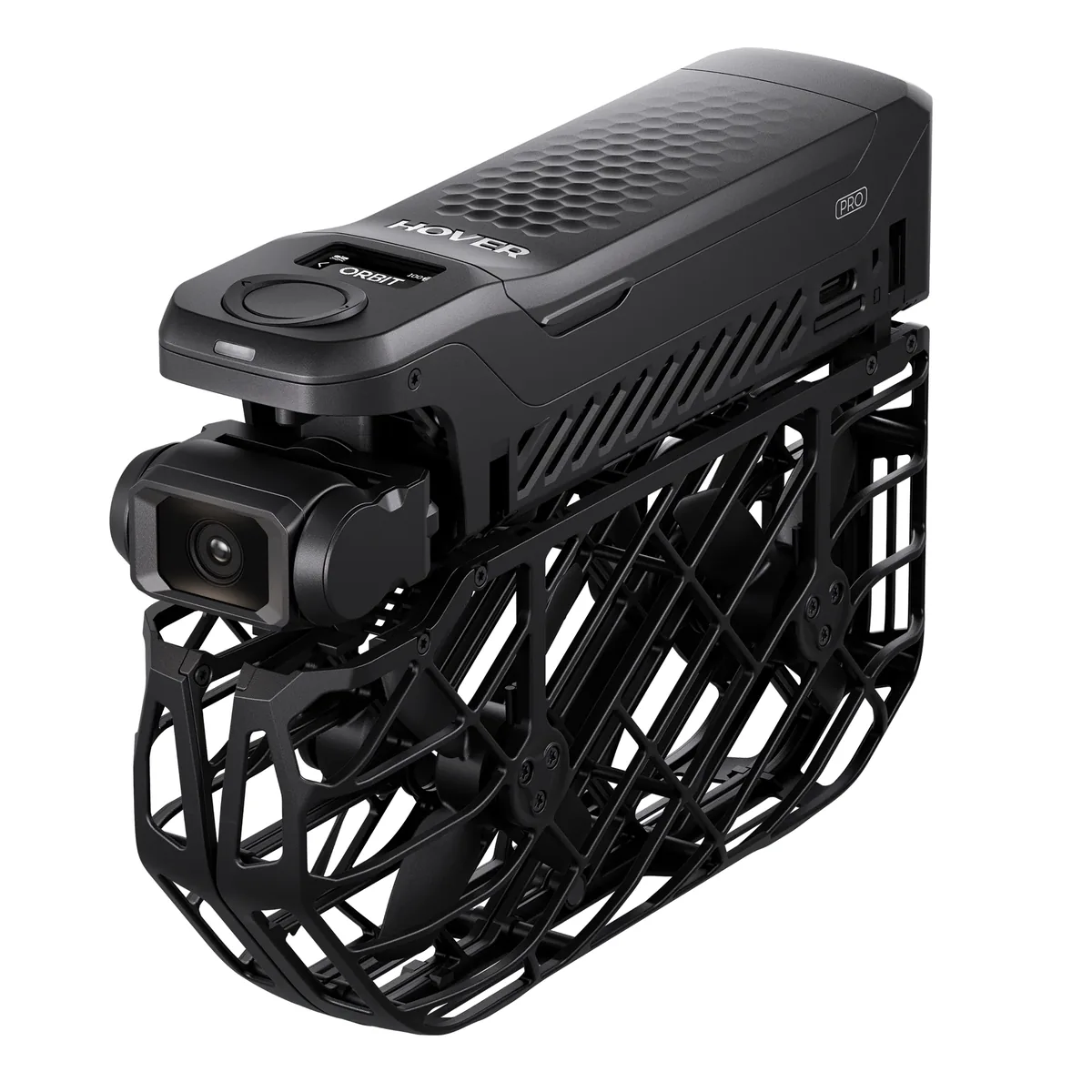
HoverAir
HoverAir X1 Pro
The jump from the original X1 is mostly the sensor: a 1/1.3-inch chip, the same size DJI puts in a Mini 4 Pro, behind a rotating camera module that shoots 4K/60 and handles portrait framing without a crop. Tracking got faster too — it will hold a rider at 26 mph — and rear and side sensors now watch the directions a following drone actually gets into trouble. Still no GPS and still no return-to-home, which is the line dividing this whole category from camera drones: if the Wi-Fi link drops, the aircraft lands rather than coming home. Sixteen claimed minutes is the other number to hold loosely, since testers running the near-identical Pro Max in tracking modes landed at 11 to 13. Worth it if you ski, ride or run and want the camera to do the following.
- Sensor
- 69.1 mm²
- Claimed
- 16 min
- Bundle
- ~$699
Best for: Action sports where the camera has to follow you
Full spec sheet