DJI
DJI Avata 2
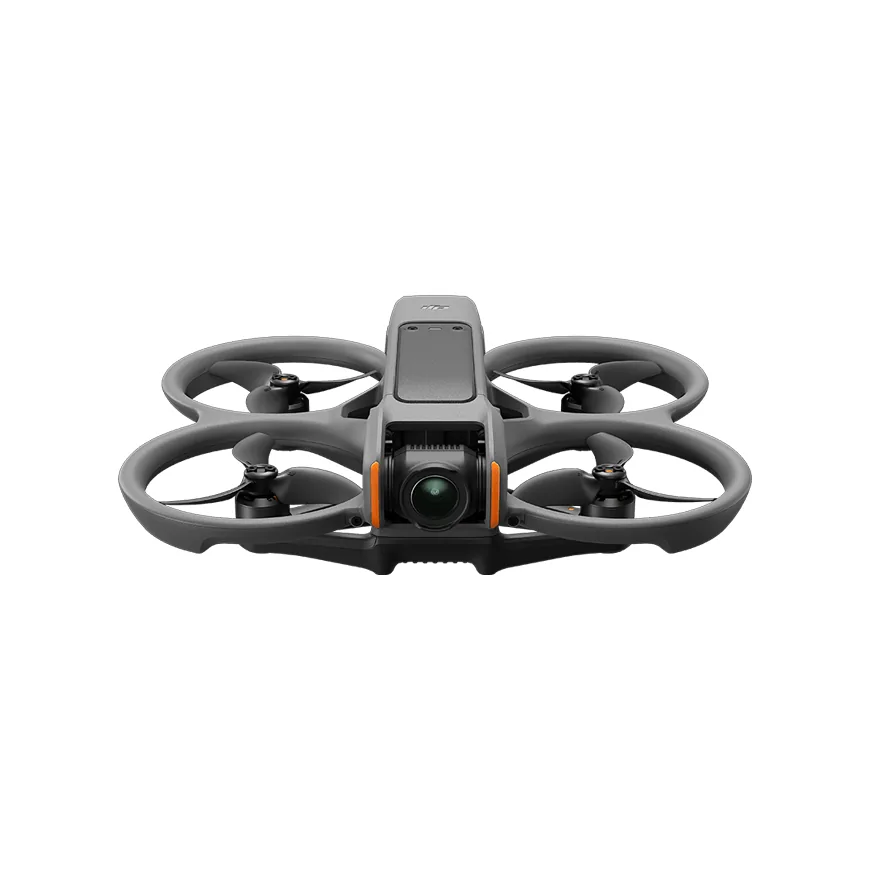
Ducted props, goggles in the box, and a flight model that forgives you — this is how most people who fly FPV now start. The Avata 2 puts a 1/1.3-inch 12MP camera on a single-axis gimbal behind full prop ducts, records 4K/60 in 10-bit D-Log M to 46 GB of internal storage, and flies on DJI Goggles 3 with the FPV Remote Controller 3. Normal mode hovers and holds position like a camera drone; Sport and Manual progressively hand you the throttle until you are flying a real quad at 60 mph. The ducts mean a clipped branch usually means a bounce rather than a repair, which is the entire reason this is a better first FPV aircraft than a bare 5-inch freestyle build. The honest limits are endurance and sensing: 23 minutes is a cruise figure, and nothing watches forward. Two things the price tag hides in both directions: the goggles and controller are the expensive half of this system and are shared with the Avata 360 and the Neo, so the cost amortises if you add another aircraft; and a ducted airframe over water has no float and no second chance.
The 250-gram line
Over 249 g: FAA registration is required ($5, 3 years) and it broadcasts Remote ID itself.
Every recreational flyer must also take TRUST and carry proof of it, at any weight. Rules checked against faa.gov on 2026-09-24. Not legal advice — how this is worked out.
What that 23-minute claim is measured at
23 minutes "flying forward at a constant speed of 21.6 kph" in windless conditions at sea level. Hovering is quoted separately at 21 minutes, and actual FPV flying — throttle punches, dives, climbs — spends the 31.7 Wh pack much faster.
That works out to 1.9 claimed minutes per $100 of the multi-battery bundle. Compared with the rest of the catalog.
Buying one in the US: limited
Checked 24 Sep 2026. Released April 2024 with FCC authorisation well before the Covered List cutoff; still sold in the US from existing inventory.
Specifications
True first-year cost: ~$1,199 — the multi-battery bundle at ~$1,199; no crash-plan price has been verified for this model, so nothing is added for it.
What it has
- Full propeller ducts — bumps bounce instead of breaking props
- 1/1.3-inch 12MP sensor, 4K/60 in 10-bit D-Log M
- 46 GB internal storage
- Normal, Sport and Manual modes on one aircraft
- O4 transmission to DJI Goggles 3, rated 13 km in FCC regions
- Backward and downward sensing with return-to-home
- Built-in Remote ID broadcast
In its favour
- The gentlest way into goggle flying — Normal mode behaves like a camera drone
- Ducts turn most contact into a bounce rather than a rebuild
- 10-bit D-Log M from an FPV aircraft is rare and genuinely gradeable
- 46 GB internal storage means no card fumbling between packs
- Return-to-home on an FPV drone, which custom builds simply do not have
Against it
- Nothing sensing forward — the ducts, not the electronics, are your protection
- 23 minutes is a cruise figure; aggressive flying roughly halves it
- Single-axis gimbal, so roll is corrected in software
- At 377 g it needs registration and Remote ID
- Locked to DJI goggles and batteries, unlike an open FPV build
The two lists above are drawn from the manufacturer’s published specifications and from the cited reviews, not from owner reports.
What owners report
Summarised from public owner discussions plus the dated, published sources listed at the end.
The Avata 2 is where most people who fly FPV now start, and owner discussions bear that out: threads are full of people with no prior stick time describing their second or third flight. Normal mode behaves like a camera drone with altitude hold, which makes day one uneventful, and Sport and Manual progressively hand over control. The ducts are what makes that progression affordable — contact with a branch is usually a bounce rather than a repair bill.
The complaint that comes up most is the link. Owners report losing signal at 100 to 200 metres when there is a building or a statue in the path, and specifically compare it unfavourably with O3 camera drones at the same distances. The consequences are worse here than on a camera drone, because what happens next is a return-to-home on an aircraft with nothing sensing forward: owners describe it flying itself into walls, and the repeated suggestion in these threads is that DJI should either use the front camera for detection or fly the aircraft home backwards so its rear sensors can see.
The other pattern is water. Losses over sea and lake are frequent enough in these discussions to be worth planning around, including one owner whose aircraft flipped and went in without wind, birds or wires to explain it. Recovery is generally not practical, and this is the strongest argument in the catalog for reading the flyaway clause of a crash-cover plan before you need it.
What owners like
- Owners with no FPV background describe it as the first drone they have owned that is not, in their words, a flying tripod — the learning curve is real but survivable
- Ducted props mean most contact is a bounce, and owners flying through gaps treat that as the entire reason to buy this rather than a bare quad
- Normal mode behaves like a camera drone, which lets people fly it from day one and move to Manual when they are ready
- 10-bit D-Log M footage from an FPV aircraft grades in a way nothing else at this price does
- 46 GB of internal storage removes card swapping between packs
Common complaints
- Transmission through obstacles is the most common complaint — owners report losing signal at 100 to 200 metres around buildings and statues, far worse than an O3 camera drone at the same distance
- Return-to-home flies blind: with no forward sensing, owners report it flying itself into walls, and several describe it as the stupidest way to lose an aircraft
- Water is unforgiving and common — owners report losses over sea and lakes with no obvious cause, and recovery is rarely practical
- Endurance in actual FPV flying is far below the 23-minute cruise figure
- Birds have attacked it in flight, which owners of larger camera drones report far less often
Questions owners ask
Why does it lose signal so close in?
Is return-to-home safe on this drone?
How many batteries does an FPV session take?
Is it a good first FPV drone?
What happens if it goes in the water?
Published sources: dji.com, oscarliang.com, uavcoach.com
DJI Avata 2, head-to-head
Shopped alongside it
More from DJI →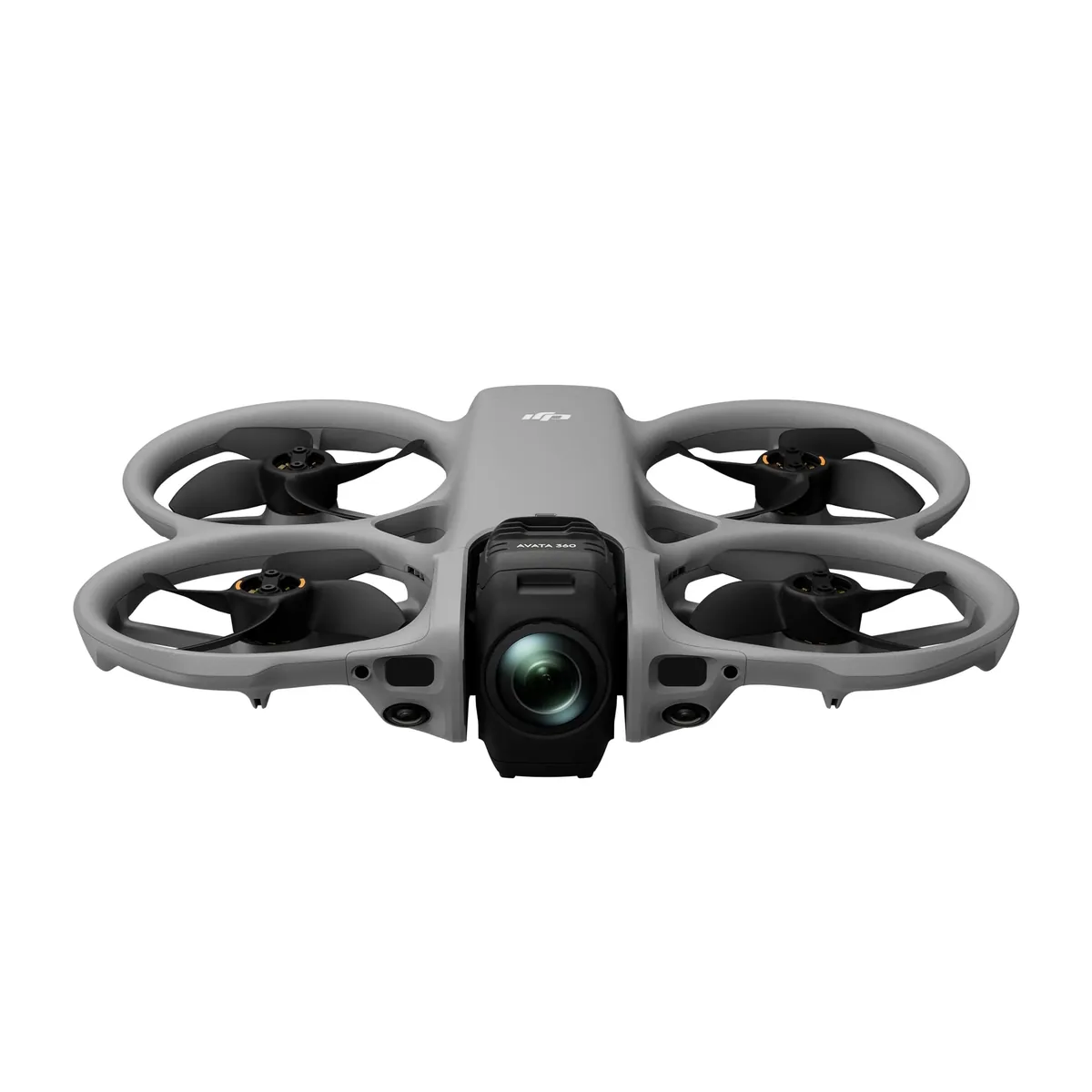
DJI's answer to the 360 drone, and the direct rival to the Antigravity A1. Dual one-inch-equivalent lenses capture 8K/60 HDR in full 360 or 4K/60 through a single lens, with 120MP stills and 42 GB of internal storage — roughly half an hour of 8K spherical footage before you need to offload. Integrated prop guards and a replaceable front lens element acknowledge what actually happens to 360 drones. Omnidirectional sensing with nightscape support and O4+ transmission to 20 km put it comfortably ahead of the Avata 2 on everything except price. At 455 grams it needs registration and Remote ID, which it broadcasts itself, and unlike most of DJI's current line it genuinely arrived in the US.
- Sensor
- 116.2 mm²
- Claimed
- 23 min
- Bundle
- ~$979
Best for: 360 capture from a maker that still ships to the US
Full spec sheet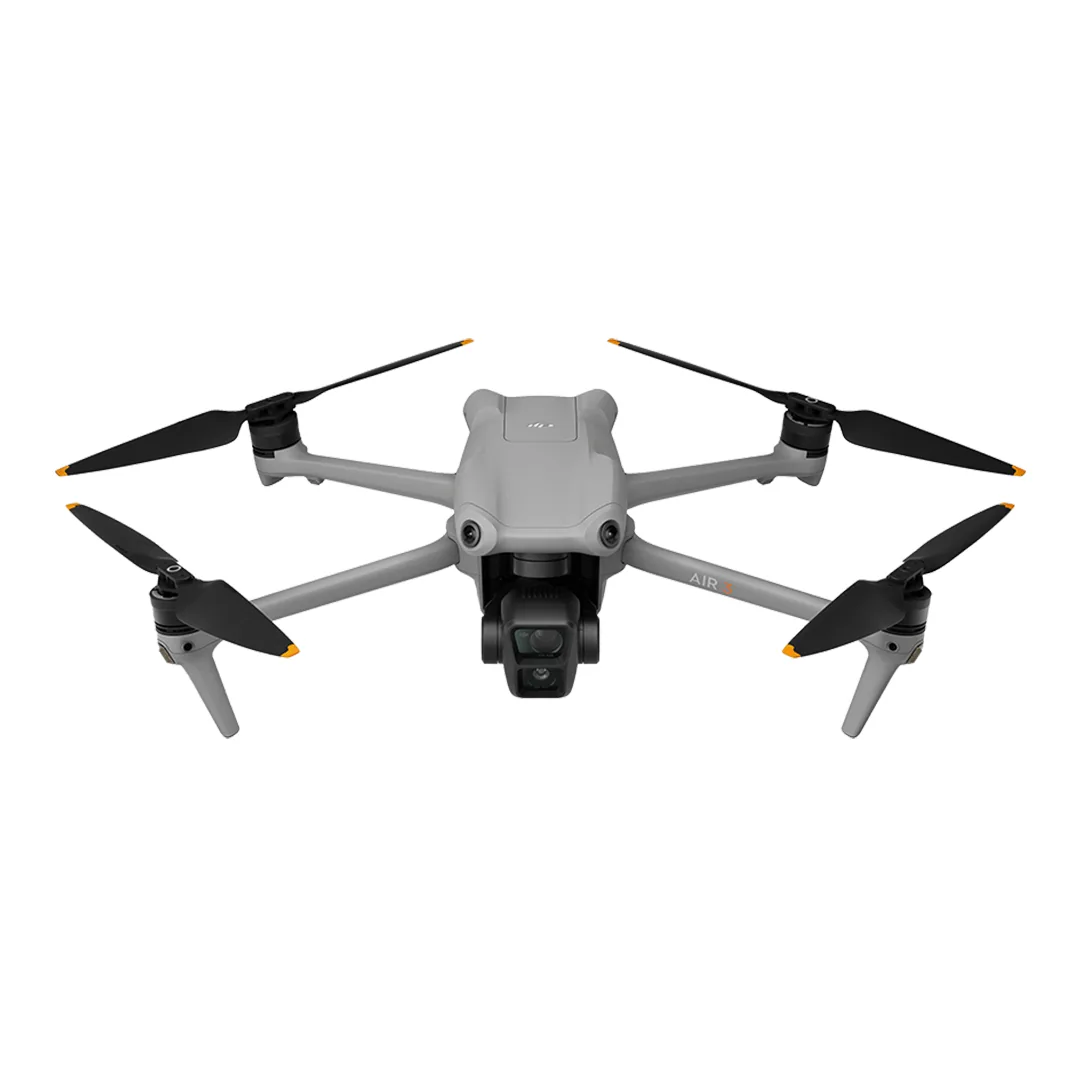
DJI
DJI Air 3
Two 1/1.3-inch cameras rather than one big one was the Air 3's bet, and for a lot of people it paid off. A 24mm wide and a 70mm medium telephoto share the same sensor size and the same 48 megapixels, so cutting between them does not produce the jarring quality drop that a small tele sensor causes. Both shoot 4K/60 HDR, 4K/100 slow motion and 10-bit D-Log M. Omnidirectional sensing, 46 claimed minutes on a 62.6 Wh pack and a 6,000 m ceiling make it the class workhorse it was meant to be. Read that 46 carefully, though: DJI quotes it with obstacle sensing switched off and the camera set to 1080p/24, which is not how anyone flies. The Air 3S replaced it with a one-inch wide camera and forward LiDAR, so the Air 3 is now the value pick in the line rather than the current one.
- Sensor
- 69.1 mm²
- Claimed
- 46 min
- Bundle
- ~$1,349
Best for: Long flights with two usable focal lengths
Full spec sheet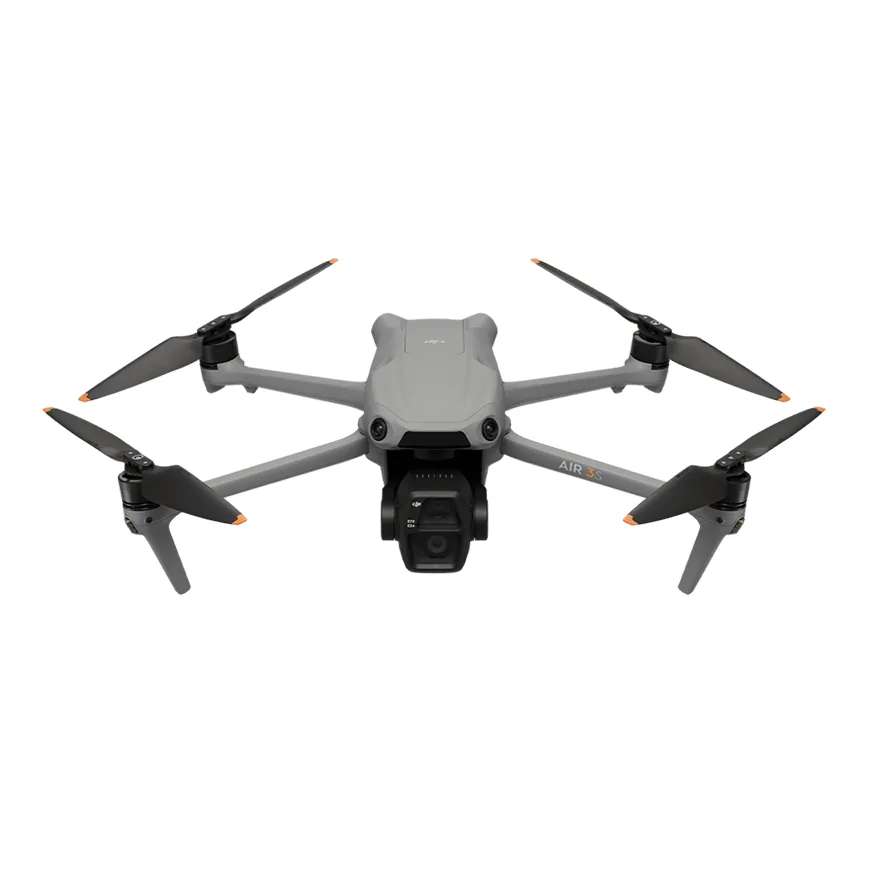
DJI
DJI Air 3S
Where the Air 3 gave you two matched 1/1.3-inch cameras, the Air 3S puts a one-inch 50MP sensor on the wide and keeps a 1/1.3-inch 48MP for the 70mm tele. That is the upgrade almost everyone wanted, and it comes with forward LiDAR bolted onto the omnidirectional vision system, which is the first time DJI's sensing has genuinely worked after dusk. Forty-two gigabytes of internal storage, a 6,000 m ceiling and 12 m/s wind resistance round it out. It sits in a strange spot in 2026: it is the best all-round camera drone DJI has FCC clearance to sell in the US, and the Mavic 4 Pro that beats it never officially arrived here. If you want one aircraft that handles wind, low light and long flights without a caveat, this is the shortest answer in the catalog.
- Sensor
- 116.2 mm²
- Claimed
- 45 min
- Bundle
- ~$1,399
Best for: One aircraft for wind, low light and long flights
Full spec sheet